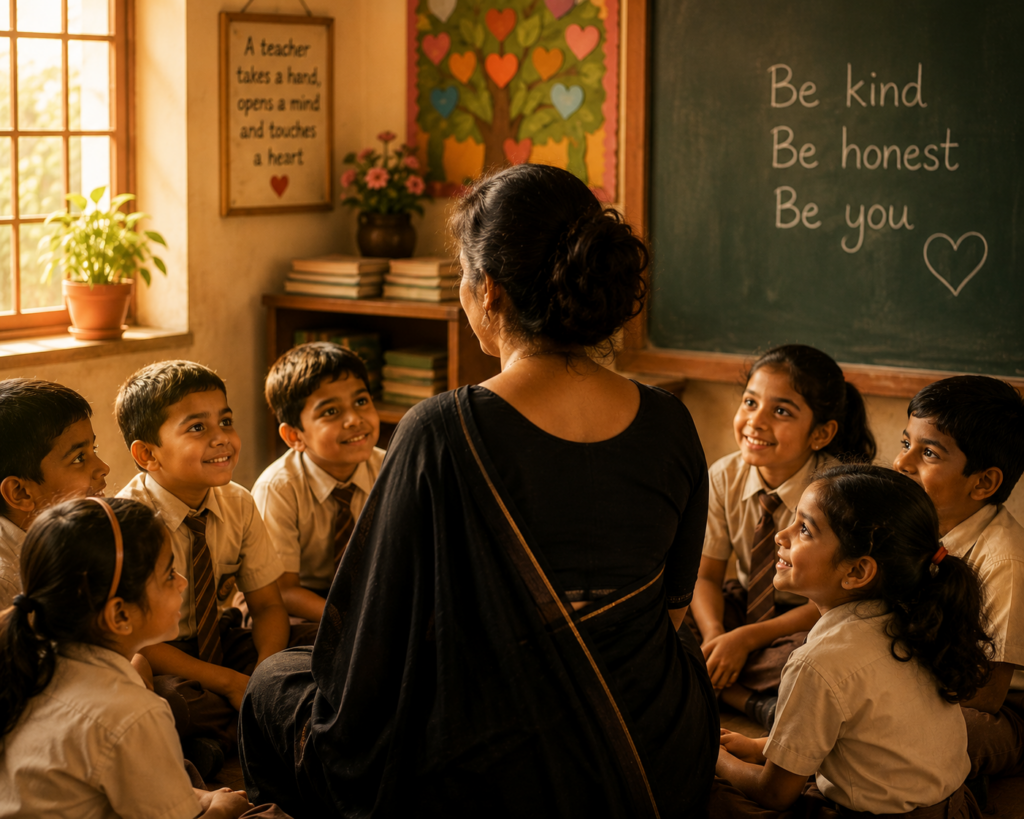
My Students, My Teachers — Forty years of stories from a teacher who believed that every lesson worth remembering began with a human being, not a textbook.
Smiles and twinkling eyes greeted me that Monday morning.
Teaching Grade 5 in my early twenties was pure pleasure. There was spontaneity in the air — students rushing to help, just to touch my hand or walk beside me to my desk in the corner of the classroom. As their class teacher, I never had to fight for attention. I had their hearts before I had their eyes.
I loved them. And I loved the attention they so generously showered on me.
That morning, stories of weekend outings and birthday parties tumbled over each other — everyone wanted to be heard first. In the middle of all that noise and warmth, I noticed something. A little chubby boy named Balesh — usually the first to greet with a smile — was frowning.
I tried to ignore it. His mood will pass, I thought.
It didn’t.
Even after a few periods, he sat there sulking — quiet in a classroom that was never quiet. I pulled him close and asked what was bothering him.
Pat came the answer: “Your black saree. I don’t like you in black. You must not wear black again.”
Not a request. A command. From a ten-year-old.
I was amused. I was taken aback. I nodded — what else could I do? — and watched a smile slowly return to his face like sunshine after a very short, very serious storm. Within minutes he was his cheerful self again, as if a grave matter of national importance had been resolved.
I smiled and moved on. Young teachers don’t dwell, I told myself.
That evening, my three-year-old daughter came home with a long face.
She was an introvert — she rarely revealed anything easily. Hours passed before I pieced together what had happened. Her teacher, a cheerful Anglo-Indian woman, had worn a short dress that day. My daughter hadn’t liked it. Not one bit. And that silent disapproval had sat on her small shoulders the entire day, heavy as stone.
I sat with that for a long time.
Two children. One day. Two teachers whose clothes had reached into young hearts and rearranged something there — without either teacher knowing.
That was the day I understood something I have never forgotten in forty years of teaching:
A teacher is a performer. And performers must know their audience.
We speak endlessly about lesson plans, learning outcomes, and teaching methods. Rarely do we speak about the unspoken language — what we wear, how we enter a room, whether our face is open or closed when a child looks up at us.
Children are watching everything. They are reading us constantly — long before we open our mouths to teach.
The chubby little boy wasn’t being difficult. He was being honest in the way only children can be — completely, immediately, and without apology.
He was, in his own ten-year-old way, teaching me.
And the best teachers, I have always believed, are the ones who never stop being students.