Picture this.
You’re sitting in a crowded café, trying to enjoy your coffee. At the next table, a four-year-old is conducting what can only be described as an emotional TED Talk. The topic? Why he absolutely must have a second chocolate muffin.
The audience was unwilling.
The child is screaming. The muffin is airborne. Nearby, the visibly exhausted parent kneels down and says calmly: “I can see you’re experiencing some very big feelings about the muffin.”
The child demonstrates excellent listening skills by immediately throwing a shoe.
Welcome to modern parenting.
In our collective effort to raise emotionally healthy children and avoid repeating the mistakes many of us experienced growing up, we embraced a new philosophy: Gentle Parenting. The intention was admirable. We wanted children who felt heard, respected, and emotionally secure. We wanted connection instead of fear. Understanding instead of punishment.
But somewhere along the way, many parents got confused about what “gentle” actually means. And in that confusion, gentle parenting sometimes transformed into something it was never meant to be: no parenting at all.
The Great Parenting Pendulum Swing
For decades, parenting often leaned toward control. Feelings weren’t discussed. Rules were non-negotiable. Obedience was the goal. Parenting often looked like: “Stop crying or I’ll give you something to cry about.”
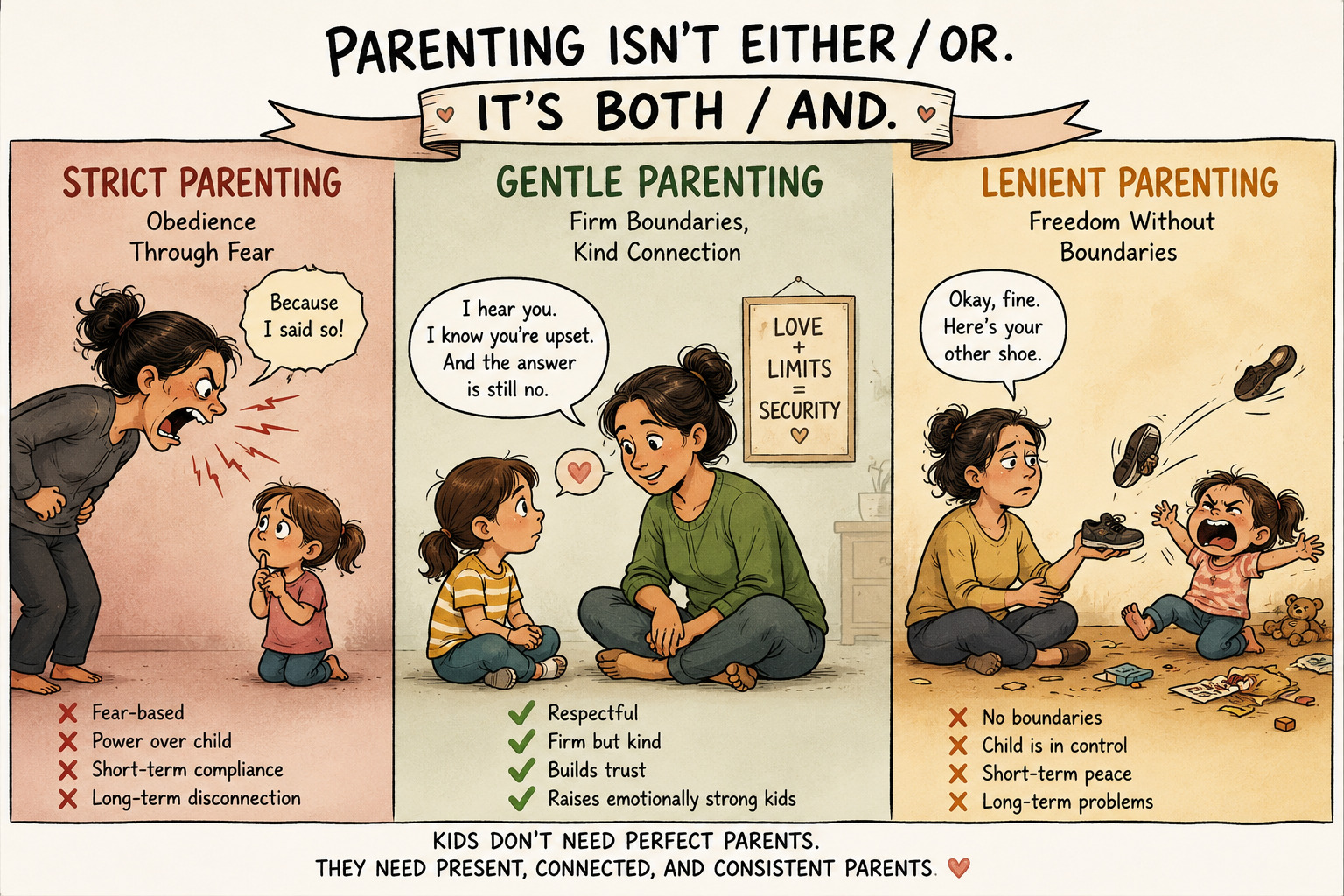
Then came a much-needed correction. The idea was simple: be kind and be the boss. The problem is that many parents embraced the kindness and quietly abandoned the boss part.
Psychologists generally describe three parenting styles. Authoritarian parenting combines high control with low warmth. Permissive parenting offers high warmth but low limits. Authoritative parenting brings both high warmth and high structure together. Research consistently shows that children tend to thrive when parents combine emotional connection with clear boundaries. In other words, true gentle parenting is much closer to authoritative parenting than permissive parenting.
Unfortunately, somewhere along the way, many parents received the memo but accidentally skipped the last page. The original message was: “Your child’s feelings matter.” What many of us heard was: “If your child ever has negative feelings, you have failed as a parent.”
If you’re negotiating every boundary with a five-year-old, you may have accidentally handed over the steering wheel.
The Most Common Misunderstanding
Here’s the mistake at the heart of modern parenting confusion: accepting an emotion does not mean accepting a behaviour. Read that again.
Your child is allowed to feel angry — but not allowed to punch their sibling. Your child is allowed to feel disappointed — but not entitled to unlimited screen time. Your child is allowed to hate bedtime — but still has to go to bed.
When screen time is over, a gentle parent might say: “I know you’re upset. You’re allowed to be angry.” But the iPad still goes away.
The challenge is that validating emotions is easy when your child is calm. It’s much harder when they’re lying on the supermarket floor demonstrating Oscar-worthy levels of despair because you won’t buy the giant dinosaur-shaped candy. At that moment, many parents abandon the boundary simply to stop the conflict.
Children do not learn emotional regulation because adults remove every frustration from their lives. They learn it when supportive adults help them move through frustration without abandoning the boundary. Permissive parenting does the opposite — it assumes that if a child is upset, the boundary must be wrong. So the parent negotiates. Bargains. Adds five more minutes. And slowly teaches the child that boundaries are optional.
That’s not empathy. That’s avoidance.
Gentle parenting doesn’t mean making sure it never rains. It means being the umbrella that doesn’t fold when your child is having a storm.
Why Children Need Boundaries More Than Endless Choices
Children often resist boundaries, but that doesn’t mean they don’t need them. Imagine standing near a cliff in complete darkness. If there’s a guardrail, you feel safe. If someone removes it because it “restricts your freedom,” you don’t feel free — you feel terrified. Suddenly every step feels uncertain.
Boundaries are the guardrails of childhood.
They tell a child: “You’re safe. Someone competent is in charge here.” Children may protest those limits. They may dislike them. They may scream dramatically about them. But deep down, boundaries create security — because they communicate something powerful: “You don’t have to run the world. I’ve got this.”
The Parenting Skill Nobody Talks About
People often think parenting is about teaching children how to regulate emotions. In reality, much of parenting is about learning how to regulate our own. Because holding a boundary while your child is furious is uncomfortable — very uncomfortable.
It’s easier to hand back the tablet. It’s easier to stay longer at the park. It’s easier to buy the candy. The hard part isn’t saying no. Many parents aren’t afraid of conflict — they’re afraid of being disliked. They’re afraid their child will think they’re mean.
But good parenting was never about avoiding discomfort. It’s about tolerating discomfort in service of your child’s long-term growth.
The Formula We Need to Remember
The goal is remarkably simple: high empathy, high boundaries. That sounds like: “I know you’re upset, and the answer is still no.” Or: “You’re angry, and I’m not going to let you hit.” Or: “You don’t want to leave the park, and we’re leaving anyway.” Or simply: “You can cry as much as you need. I’m staying with you.”
The Parent Your Child Actually Needs
Children do not need adults who eliminate every disappointment, frustration, or uncomfortable emotion. They need adults who can sit beside them through those emotions without losing confidence in their own leadership.
The goal is not obedience at all costs. Nor is it endless negotiation. The goal is raising children who feel both deeply loved and securely guided.
Sometimes love is measured by how many tears you’re willing to sit beside without changing a necessary boundary — when every cell in your body wants to give in.
Gentle parenting was never meant to be a white flag of surrender. Because being gentle isn’t the absence of strength. That isn’t weakness. That’s leadership.
The next time you’re in that café, watching a four-year-old negotiate for a second muffin — smile. You already know what to do.